
Purpose
The purpose of this investigation is to determine the effect that varying temperatures have on the rate of a reaction.
Introduction
Based on the Kinetic Molecular Theory, the central idea of the collision model is that molecules must collide to react. Therefore, the greater number the number of collisions per second, the greater the reaction rate.
The collision energy depends directly on the kinetic energy of colliding particles, and the temperature is a measure of the average kinetic energy of the particles in a substance.
Thus, as the temperature of a substance increases, the average kinetic energy of the particles increases. Consequently, there will be a greater number of collisions per second and a greater reaction rate.
Materials
- Distilled Water
- Erlenmeyer Flask
- Graduated Cylinder
- Bunsen Burner
- Retort Stand
- Ring Clamp
- Thermometer
- Stopwatch
- Sandpaper
- Mass Balance
- Ice
- HCl (aq)
- Mg(s)
Procedure
- Create 50.0mL of 2.00M of HCl(aq) using 16mL of hydrochloric acid and 34mL of distilled water
- Pour 50.0mL of diluted solution into the Erlenmeyer flask.
- Measure 0.200g of Mg(s). Make sure to clean the magnesium with the sandpaper before weighing it, in order to remove any impurities.
- Set up retort stand with ring clamp and Bunsen burner
- Heat the 50.0mL of HCl(aq) 70.0oC.
- Place 0.200g of Mg(s) into heated HCl(aq).
- Use stopwatch to record the time of reaction from beginning to end.
- Perform steps 1-7 three times to obtain 3 trials
- Perform steps 1-8 with HCl(aq) at 40.0oC and 10.0oC, keeping the amt of Mg(s) constant
Observations
Table 1: Observations for Temperature 1
| Trial # | Temperature of HCl (±0.05oC) | Mass of Mg
(±0.001g) | Time of Reaction (±0.001s) |
| 1 | 70.0 | 0.200 | 30.08 |
| 2 | 70.0 | 0.198 | 29.41 |
| 3 | 70.0 | 0.197 | 30.52 |
Table 2: Observations for Temperature 2
| Trial # | Temperature of HCl (±0.05oC) | Mass of Mg
(±0.001g) | Time of Reaction (±0.001s) |
| 1 | 40.0 | 0.199 | 37.28 |
| 2 | 40.0 | 0.204 | 36.59 |
| 3 | 40.0 | 0.198 | 37.89 |
Table 3: Observations for Temperature 3
| Trial # | Temperature of HCl (±0.05oC) | Mass of Mg
(±0.001g) | Time of Reaction (±0.001s) |
| 1 | 10.0 | 0.199 | 45.84 |
| 2 | 10.0 | 0.198 | 44.54 |
| 3 | 10.0 | 0.199 | 45.12 |
Calculations and Data Processing
Calculating Average Mass and Time
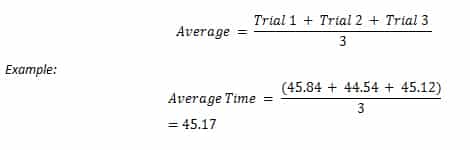
Table 4: Averaged values for Temperature and Time
| Temperature of HCL(aq) (±0.05oC) | Mass of Mg(s) (±0.001g)1.5%) | Time (s) (±0.003s) |
| 70.00 | 0.20 | 30.00 |
| 40.00 | 0.20 | 37.25 |
| 10.00 | 0.20 | 45.17 |
Calculating Moles of Mg(s)
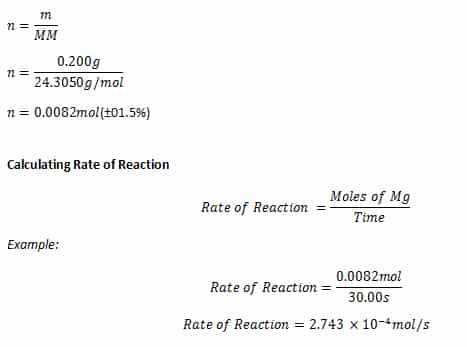
Table 5: Rate of Reaction of Mg with HCl
| Temperature of HCL(aq) (±0.05oC) | Mass of Mg(s) (1.50%) | Time (s) (±0.003s) | Rate of Reaction (±3.00%) |
| 70 | 0.200 | 30.00 | 0.0067 |
| 40 | 0.200 | 37.25 | 0.0054 |
| 10 | 0.200 | 45.17 | 0.0044 |
Graph 1: Temperature of HCl vs. Rate of Reaction
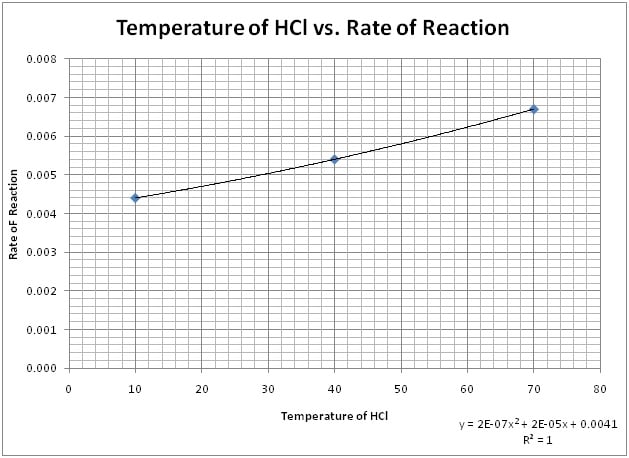
Graph 1 shows the relationship between change in temperature and the rate of reaction. The trend shows that as the temperature of the HCl increases, so does the rate of reaction. This is a polynomial relationship, which implies that the rate of reaction increases exponentially in relation to the increase in temperature.
Conclusion and Evaluation
As discussed in the introduction, the relationship between temperature and reaction rate is explained through the Collision Model and the Kinetic Molecular theory. These two theories justify the corresponding increase of both factors. The Kinetic Molecular Theory states that temperature is a measure of the average kinetic energy of the particles
Thus, Due to the increase in temperature the average kinetic energy of the particles increases proportionally thus resulting in higher overall entropy. Therefore due to an increase in the average kinetic energy of the particles, the collision rate increases proportionally resulting in a higher rate of reaction.
In conclusion, this experiment was successful in determining the relationship between temperature and reaction rate. It showed that temperature and rate of reaction increase proportionally due to a greater number of collisions.
Although the experiment was successful in showing the relationship discussed above, there are a few errors associated with this experiment that could have hindered the accuracy of the results. This error amounts to approximately 3%, which is insignificant to the general trend. However, in regards to specific rates of reaction, they affect the accuracy.
One factor that could have affected the accuracy of this experiment is the fact that each solution of HCl was diluted separately. This allows for greater error as each time something is measured there is an error associated with the piece of equipment used. This could have been avoided by making a large amount of the HCl in the desired concentration at the beginning of the experiment.
Another factor that could have affected the accuracy is the fluctuation in room temperature during this experiment. This could have increased or decreased the temperature of the HCl during the reaction. In order to avoid this problem, the reaction should be conducted in a closed room with a stable room temperature.
Furthermore, some reactions can be sped up depending on how much light they are exposed to. This experiment was performed in an open classroom with bright lights and open windows. Thus, this light could have increased the energy of the particles participating in the reaction, and thus increase the inaccuracy because this is an external factor affecting the rate of reaction. Once again, this can be avoided by performing the experiment in a closed room.
In conclusion, although there were some errors associated with this experiment, it was successful in determining the relationship between temperature and reaction rate. It showed that temperature and rate of reaction increase proportionally due to a greater number of collisions.


can someone explain how they got from 2.67 x 10^-4 to 0.0067?? Confusing. I don’t understand this. Where did 0.0067 come from?
Thank you so much, I found this very helpful
thanks
very helpful
science is fun…. especially chemistry…. NOT!!!
hi i love science
*helpful